
What Is Performance Marketing? A Complete Guide for Businesses
Imagine spending thousands of rupees on advertising without knowing whether it generated a single customer.
This is one of the biggest problems businesses have faced with traditional advertising. You may receive impressions, views, likes, and website traffic, but an important question remains:
Did your marketing actually generate results?
This is where Performance Marketing becomes valuable.
Performance Marketing is a results-driven approach where businesses measure marketing campaigns based on specific actions. These actions can include clicks, leads, form submissions, app installs, purchases, phone calls, or other valuable conversions.
Instead of simply asking, “How many people saw our advertisement?”, Performance Marketing focuses on questions such as:
- How many leads did the campaign generate?
- How much did each lead cost?
- Which campaign generated the most sales?
- What is the return on advertising spend?
- Which marketing channel is most profitable?
In simple words, Performance Marketing helps businesses connect their marketing investment with measurable outcomes.
It is an important part of a modern Digital Marketing strategy because it allows businesses to use data, tracking, and continuous optimization to improve results.
What Is Performance Marketing?
Performance Marketing is a type of Digital Marketing where advertisers and marketers focus on measurable results or specific customer actions.
The desired action can vary depending on the business objective.
For example, a Performance Marketing campaign may focus on:
- Generating leads
- Increasing product sales
- Driving website conversions
- Getting app installations
- Increasing newsletter subscriptions
- Generating phone calls
- Driving registrations
According to Salesforce’s Performance Marketing guide, Performance Marketing focuses on measurable actions and allows marketers to evaluate campaign effectiveness using performance data.
The main difference is that success is not measured only by visibility.
Instead, marketers track actions that contribute to real business goals.
A Simple Example
Suppose a company spends ₹20,000 on an advertising campaign.
The campaign generates:
- 10,000 ad impressions
- 500 website visitors
- 50 leads
- 10 customers
A Performance Marketing approach helps the company understand:
- Cost per click
- Cost per lead
- Conversion rate
- Customer acquisition cost
- Revenue generated
This information makes it easier to decide whether the campaign should be continued, improved, or stopped.
Understanding Digital Marketing Meaning
Before understanding Performance Marketing in detail, it is helpful to understand the broader Digital Marketing Meaning.
Digital Marketing refers to promoting products, services, and brands through digital channels and online platforms.
These channels include:
- Search engines
- Social media platforms
- Websites
- Mobile applications
- Online advertising platforms
- Content platforms
For businesses, Digital Marketing services can combine multiple strategies to increase online visibility, attract potential customers, and improve conversions.
Performance Marketing is one part of this larger ecosystem.
For example:
- SEO focuses on improving organic visibility.
- Content Marketing focuses on attracting and educating audiences.
- Social Media Marketing focuses on audience engagement.
- PPC focuses on paid traffic.
- Performance Marketing focuses strongly on measurable outcomes.
These strategies can work together as part of a complete Marketing Strategy.
How Does Performance Marketing Work?
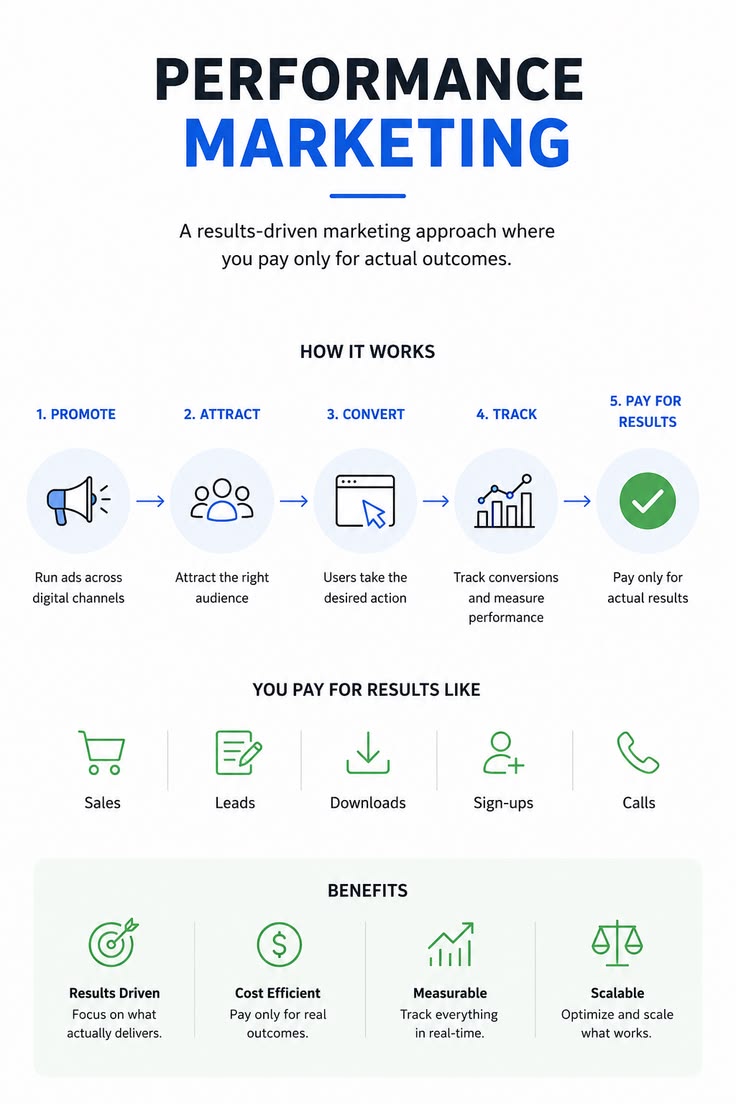
Performance Marketing usually follows a structured process.
Business Goal → Target Audience → Campaign → Tracking → Conversion → Optimization
Let’s understand each stage.
1. Define a Clear Business Goal
Every successful Performance Marketing campaign starts with a clear objective.
Common goals include:
- Generate 100 qualified leads
- Increase online sales
- Get more phone enquiries
- Increase website conversions
- Drive app downloads
- Generate consultation bookings
For example:
❌ “We want more customers.”
A better objective would be:
✅ “Generate 50 qualified leads per month at a target cost of ₹500 per lead.”
A clear objective helps marketers select the right platforms, campaign structure, and performance metrics.
2. Identify Your Target Audience
The next step is understanding who is most likely to become a customer.
Audience targeting may include:
- Location
- Age group
- Interests
- Search behaviour
- Profession
- Online activity
- Previous website visitors
- Purchase intent
For example, a company offering digital marketing services may target:
- Business owners
- Startup founders
- E-commerce companies
- Marketing managers
- Local businesses
The more relevant the audience, the better the chances of generating quality conversions.
For businesses using paid social campaigns, Social Media Advertising can help reach targeted audiences across platforms such as Facebook, Instagram, and LinkedIn.
3. Select the Right Performance Marketing Channel
Not every channel works equally well for every business.
The right channel depends on:
- Your target audience
- Business model
- Product or service
- Customer buying journey
- Campaign objective
- Budget
Popular Performance Marketing Channels Include:
- Google Ads
- Social Media Advertising
- Display Advertising
- Affiliate Marketing
- Email Marketing
- Remarketing
- PPC Advertising
For example, Google Search Ads can work well when people are actively searching for a solution.
A user searching for:
“best digital marketing agency near me”
may already have strong purchase intent.
On the other hand, a new product may benefit more from social media advertising, where marketers can introduce the product to a relevant audience.
Major Performance Marketing Channels
1. PPC Advertising
Pay-Per-Click advertising is one of the most popular forms of Performance Marketing.
Advertisers pay when users interact with an advertisement, depending on the campaign model.
Common platforms include:
- Google Ads
- Microsoft Advertising
- Social advertising platforms
PPC campaigns can help businesses reach users who are actively searching for products or services.
A strong PPC campaign requires:
- Keyword research
- Relevant targeting
- Compelling ad copy
- Conversion tracking
- Landing page optimization
Performance should always be evaluated based on meaningful outcomes rather than clicks alone.
2. Social Media Advertising
Social Media Advertising allows businesses to reach audiences based on interests, demographics, behaviour, and other targeting options.
Popular platforms include:
Social advertising can support:
- Lead generation
- E-commerce sales
- Brand awareness
- Website traffic
- Remarketing
KRK Digitals offers Social Media Advertising services focused on targeted campaigns designed to improve reach, engagement, and conversions.
However, successful campaigns require more than simply boosting a post.
Marketers need to test:
- Different creatives
- Headlines
- Audiences
- Offers
- Call-to-actions
3. Email Marketing
Email Marketing is another valuable channel that can support Performance Marketing.
While email campaigns are often associated with communication and customer nurturing, they can also generate measurable business outcomes.
Email campaigns can track:
- Open rates
- Click-through rates
- Website visits
- Product purchases
- Registrations
- Lead conversions
For example, a customer journey might look like this:
Social Media Ad → Landing Page → Lead Form → Email Marketing → Sales Call → Customer
This highlights an important point:
Performance Marketing is not always about one platform. It is often about how multiple marketing channels work together.
Email can help businesses stay connected with potential customers and guide them through the buying journey.
4. Affiliate Marketing
Affiliate Marketing is another results-focused marketing model.
In this approach, businesses work with affiliates, publishers, or creators who promote their products or services.
The affiliate may receive compensation when a specific action occurs, such as:
- A sale
- A lead
- A subscription
This approach can help businesses expand their reach while connecting marketing costs with measurable actions.
5. Search Engine Optimization and Performance
SEO is not typically considered paid Performance Marketing because businesses do not pay for each conversion or click.
However, Search Engine Optimization plays an important role in a complete Digital Marketing strategy.
SEO helps businesses:
- Improve search visibility
- Generate organic traffic
- Attract relevant visitors
- Build long-term digital presence
The website can then measure performance through:
- Organic leads
- Organic conversions
- Revenue from organic traffic
- Conversion rates
KRK Digitals also emphasizes keyword research, technical optimization, content, and internal linking as part of SEO services.
This demonstrates an important idea:
Performance thinking can be applied to almost every marketing channel.
Performance Marketing vs Traditional Marketing
| Feature | Performance Marketing | Traditional Marketing |
|---|---|---|
| Main Focus | Measurable results | Broad reach and awareness |
| Measurement | Data-driven | Often difficult to measure |
| Optimization | Continuous | Limited after launch |
| Targeting | Specific audiences | Broader audiences |
| Budget Control | Flexible | Usually fixed |
| Key Metrics | Leads, sales, CPA, ROAS | Reach and exposure |
Traditional marketing can still be valuable for building awareness.
However, Performance Marketing gives businesses more visibility into how their marketing investment contributes to measurable outcomes.
The strongest Marketing Strategy often combines both:
Brand Building + Performance Measurement
Performance Marketing vs Brand Marketing
Performance Marketing and Brand Marketing have different objectives.
Performance Marketing Focuses On:
- Leads
- Sales
- Conversions
- Customer acquisition
- ROI
- Measurable results
Brand Marketing Focuses On:
- Awareness
- Trust
- Recognition
- Reputation
- Long-term customer relationships
These approaches should not necessarily compete with each other.
A strong brand can improve the performance of advertising campaigns because customers are often more likely to trust a familiar business.
Therefore, a balanced approach is:
Build brand trust while measuring marketing performance.
Content Marketing can play an important role here by helping businesses create useful content that builds credibility and audience trust over time.
Important Performance Marketing Metrics
Performance Marketing depends heavily on measuring the right metrics.
1. Cost Per Click (CPC)
CPC measures how much an advertiser pays for each click.
Formula:
Total Advertising Cost ÷ Number of Clicks
2. Click-Through Rate (CTR)
CTR measures the percentage of people who click an advertisement after seeing it.
Formula:
Clicks ÷ Impressions × 100
A strong CTR can indicate that the advertisement is relevant and attractive to the target audience.
3. Cost Per Lead (CPL)
CPL measures how much it costs to generate one lead.
Formula:
Total Campaign Cost ÷ Number of Leads
For service businesses, this is often an important performance metric.
However, marketers should also consider lead quality.
Generating 100 low-quality leads may be less valuable than generating 20 highly qualified leads.
4. Cost Per Acquisition (CPA)
CPA measures how much a business spends to acquire a customer or generate a desired conversion.
This is especially important for understanding whether marketing campaigns are financially sustainable.
5. Conversion Rate
Conversion rate measures the percentage of visitors who complete a desired action.
The action could include:
- Completing a form
- Making a purchase
- Booking a consultation
- Signing up
Formula:
Conversions ÷ Total Visitors × 100
Improving this metric is where Conversion Rate Optimization becomes important.
Conversion Rate Optimization (CRO) focuses on improving website design, content, and user experience to encourage more visitors to take meaningful actions.
6. Return on Ad Spend (ROAS)
ROAS measures how much revenue is generated from advertising spend.
Formula:
Revenue Generated ÷ Advertising Cost
For example:
If you spend ₹10,000 on advertising and generate ₹50,000 in revenue:
ROAS = 5x
This means every ₹1 spent generated ₹5 in revenue.
7. Return on Investment (ROI)
ROI measures the overall profitability of marketing investment.
Revenue alone does not always indicate success.
A campaign may generate significant revenue but still be unprofitable because of:
- High advertising costs
- Product costs
- Operational expenses
- Sales expenses
This is why businesses should connect marketing performance with actual business profitability.
Why Landing Pages Matter in Performance Marketing
One of the biggest mistakes businesses make is focusing only on advertisements.
An advertisement may generate:
- High impressions
- Good CTR
- Significant traffic
But still produce poor results.
Why?
Because the landing page is not converting visitors.
A strong landing page should include:
- A clear headline
- Strong value proposition
- Relevant information
- Trust signals
- Fast loading speed
- Mobile-friendly design
- Simple forms
- Clear call-to-action
For example:
Weak CTA:
“Submit”
Stronger CTA:
“Get Your Free Marketing Consultation”
The landing page should make the next step clear.
This is why Performance Marketing works closely with website development and CRO.
KRK Digitals offers web development solutions designed to create responsive and user-friendly websites that support business growth.
Benefits of Performance Marketing
1. Better Budget Control
Performance data helps businesses understand where their money is going.
Businesses can:
- Increase budgets for profitable campaigns
- Pause poor-performing campaigns
- Test new opportunities
- Reduce unnecessary spending
2. Measurable Results
Businesses can track valuable actions such as:
- Leads
- Sales
- Revenue
- Calls
- Registrations
This provides more transparency than relying only on impressions or reach.
3. Continuous Optimization
Performance Marketing campaigns can be improved continuously.
Marketers can test:
- New audiences
- Different advertisements
- Landing pages
- Keywords
- Offers
- CTAs
The goal is not simply to launch a campaign.
The goal is to continuously improve it.
4. Better Audience Targeting
Digital platforms allow businesses to reach more relevant audiences.
Targeting can be based on:
- Interests
- Location
- Search intent
- Previous interactions
- Demographics
Better targeting can improve campaign efficiency and conversion potential.
5. Scalable Growth
Once businesses identify campaigns that generate profitable results, they may be able to scale them.
However, scaling should be done carefully.
A campaign performing well at ₹1,000 per day may not necessarily perform the same way at ₹50,000 per day.
Continuous monitoring is essential.
Challenges of Performance Marketing
Performance Marketing is powerful, but it is not a guaranteed solution.
Campaigns can fail because of:
- Poor targeting
- Weak advertisements
- Low-quality landing pages
- Poor offers
- Incorrect tracking
- High competition
- Slow websites
- Poor customer experience
One of the most important lessons is:
Advertising can increase visibility, but it cannot permanently fix a weak product or service.
Before increasing the advertising budget, businesses should evaluate:
- Product-market fit
- Pricing
- Customer experience
- Website performance
- Sales process
Performance Marketing works best when the complete customer journey is optimized.
How to Build an Effective Performance Marketing Strategy
Step 1: Define Your Objective
Start with a clear business goal.
For example:
- Generate leads
- Increase sales
- Get more calls
- Increase registrations
Avoid vague objectives.
Step 2: Understand Your Target Audience
Research:
- Who are your customers?
- What problems do they have?
- Where do they spend time online?
- What motivates them to buy?
Audience understanding is the foundation of a successful campaign.
Step 3: Select the Right Channel
Choose channels based on your customer journey.
For example:
- Search Ads for high-intent users
- Social Media Ads for audience targeting
- Email Marketing for nurturing
- SEO for long-term organic growth
A complete Digital Marketing strategy can combine these channels based on business objectives.
Step 4: Create a Strong Offer
Your advertisement should communicate a clear reason for customers to take action.
Examples:
- Free consultation
- Limited-time discount
- Free demo
- Free audit
- Exclusive offer
The offer should provide genuine value.
Step 5: Set Up Accurate Tracking
Track the actions that matter.
For example:
- Form submissions
- Phone calls
- Purchases
- Registrations
Without accurate tracking, businesses may optimize campaigns based on incomplete information.
Step 6: Test Multiple Variations
Test:
- Headlines
- Images
- Videos
- Audiences
- CTAs
- Landing pages
Do not assume the first campaign will produce the best results.
Testing helps marketers discover what works best.
Step 7: Optimize Based on Data
Regularly analyze:
- Which campaigns generate leads?
- Which leads become customers?
- Which channel produces the best ROI?
- Which advertisements should be paused?
Data should guide decisions.
The Future of Performance Marketing
Performance Marketing is evolving rapidly.
Businesses are increasingly focused on:
- Better data analysis
- Automation
- AI-powered optimization
- First-party data
- Cross-channel measurement
- Customer journey analysis
The future is not simply about generating more clicks.
It is about understanding the complete customer journey.
For example:
Advertisement → Website Visit → Lead → Sales Call → Customer → Repeat Customer
A campaign should ideally be evaluated based on the complete journey rather than only the first conversion.
This is where Performance Marketing becomes more than advertising.
It becomes a powerful system for understanding business growth.
A Fresh Perspective: Performance Marketing Is About Smarter Decisions
Many people think Performance Marketing simply means running paid advertisements.
But the bigger picture is different.
At its core, Performance Marketing is about answering important business questions with data.
For example:
- Which audience is most profitable?
- Which service generates the best leads?
- Which campaign generates real customers?
- Where should we invest more money?
This makes Performance Marketing closely connected with business intelligence.
The goal should not simply be:
“Get more leads.”
The better question is:
“How can we generate profitable and high-quality customers?”
That shift in thinking can make a major difference.
Conclusion: Is Performance Marketing Right for Your Business?
Performance Marketing is one of the most effective Digital Marketing approaches for businesses that want measurable and data-driven growth.
It helps businesses track:
- Leads
- Sales
- Conversions
- Advertising costs
- Revenue
- ROI
However, successful Performance Marketing requires more than running advertisements.
You need:
- Clear business goals
- The right target audience
- Strong advertising campaigns
- Effective landing pages
- Accurate tracking
- Continuous optimization
- A complete Marketing Strategy
The biggest advantage is accountability.
Instead of simply saying:
“We are spending money on marketing.”
Businesses can ask:
“What results are we getting from our marketing investment?”
That is the real power of Performance Marketing.
At KRK Digitals, the focus is on building customized digital strategies and measuring campaign performance to support business growth. The company’s services span SEO, PPC, social media advertising, content marketing, CRO, web development, and other digital solutions.
Ready to Improve Your Marketing Performance?
If you want to build a data-driven Performance Marketing strategy focused on leads, conversions, and measurable growth, explore KRK Digitals’ Digital Marketing Services.
Whether your business needs SEO, paid advertising, social media campaigns, content marketing, or conversion optimization, the right strategy can help you turn digital marketing efforts into meaningful business results.
Start tracking what matters, optimize what works, and build a smarter path to business growth.