
Search engine optimization is evolving faster than ever. In 2026, artificial intelligence is transforming the way people search for information, discover businesses, compare products, and make purchasing decisions.
Traditional SEO is no longer only about ranking a webpage at the top of search engine results. Today, businesses also need to think about how their content appears in AI-powered search experiences, including AI-generated answers, conversational search, AI Overviews, and other generative search features.
The good news is that SEO is not disappearing. In fact, Google’s current guidance is clear that strong foundational SEO remains important for visibility in generative AI search experiences. The focus is shifting toward helpful, original, reliable, and people-first content.
In this article, we will explore how AI search is changing SEO in 2026 and what businesses need to do to stay competitive.
What is AI Search is changing SEO?
AI search refers to search experiences that use artificial intelligence to understand user questions, analyze information from multiple sources, and provide direct or conversational answers.
Instead of simply showing a list of blue links, AI-powered search can help users:
- Get summarized answers
- Compare products and services
- Ask follow-up questions
- Explore complex topics
- Discover relevant websites
- Find recommendations
- Make decisions faster
Examples of AI-powered search experiences include Google’s AI features, AI Overviews, AI Mode, and conversational AI platforms.
Google describes AI Overviews as AI-generated snapshots that can help users quickly understand information while providing links to explore relevant sources further.
This change means businesses must think beyond traditional keyword rankings.
How Is AI Search Changing SEO in 2026?
AI is changing SEO in several important ways. Search engines are becoming better at understanding meaning, context, user intent, and relationships between different topics.
Here are some of the biggest changes businesses should understand.
1. Search Is Becoming More Conversational
Traditional search queries were often short and simple.
For example:
Digital marketing agency Delhi
However, users increasingly ask more detailed questions such as:
Which digital marketing agency in Delhi is best for SEO and lead generation for a small business?
AI-powered search systems are designed to understand these longer and more conversational queries.
This means businesses should focus less on repeating the same keyword multiple times and more on answering real customer questions.
Instead of creating content only around keywords, create content around:
- Customer problems
- Questions
- Search intent
- Buying decisions
- Comparisons
- Solutions
- Industry expertise
A strong SEO strategy in 2026 focuses on understanding what users actually want.
2. Helpful and Original Content Is More Important Than Ever
AI can generate thousands of articles quickly. However, creating a large amount of generic AI-generated content does not automatically improve search visibility.
Google specifically warns against generating large numbers of pages without providing value to users, as this may violate its spam policies related to scaled content abuse.
Businesses should focus on creating content that includes:
- Original insights
- Real experience
- Expert knowledge
- Useful examples
- Accurate information
- Case studies
- Customer-focused solutions
For example, instead of publishing a generic article about SEO, a digital marketing agency can create content based on real experiences, such as:
How We Improved Organic Traffic for a Local Business
This type of content can provide more unique value than generic information that already exists on hundreds of websites.
3. Keywords Are Still Important, but Context Matters More
Keywords are not dead.
However, keyword stuffing and excessive repetition are no longer effective strategies.
AI-powered search systems are better at understanding:
- Synonyms
- Context
- User intent
- Related topics
- Natural language
For example, a page optimized for digital marketing services may also be relevant to searches related to:
- Online marketing services
- Digital advertising services
- SEO and social media marketing
- Internet marketing company
You do not need to repeat every possible keyword variation unnaturally.
Google’s guidance for generative AI search emphasizes that systems can understand meaning and synonyms, so creating useful content for users is more important than trying to capture every possible keyword variation.
The best approach is to use keywords naturally while covering the complete topic.
4. AI Search Rewards Clear Answers
AI-powered search experiences often look for useful information that can help answer a user’s question.
Businesses should structure their content clearly.
For example:
Question
What is SEO?
Clear Answer
SEO, or Search Engine Optimization, is the process of improving a website’s visibility in search engine results to attract relevant organic traffic.
This approach helps users quickly understand important information.
Use:
- Clear headings
- Short paragraphs
- Lists
- Definitions
- FAQs
- Step-by-step instructions
- Tables where appropriate
However, businesses should not create artificial content structures only for AI systems. Google says there is no special requirement to break content into tiny pieces or rewrite content specifically for generative AI. The priority should remain useful content for real users.
5. Brand Authority Is Becoming More Important
When AI systems help users find information, trust becomes extremely important.
Businesses should focus on building a strong and trustworthy online presence.
This includes:
- A professional website
- Helpful blog content
- Accurate business information
- Strong brand messaging
- Customer reviews
- Industry expertise
- Original content
- Author credibility
Your website should clearly explain:
- Who you are
- What services you provide
- Who you help
- Why customers should trust you
- How users can contact you
Businesses that build real authority are better positioned for long-term visibility than websites relying on shortcuts or low-quality content.
6. Technical SEO Still Matters
Some people believe AI search will eliminate the need for technical SEO.
That is incorrect.
Google’s official guidance explains that foundational technical SEO remains important for generative AI search visibility. Content still needs to be crawlable, accessible, and eligible to appear in Search.
Businesses should continue to focus on:
- Website speed
- Mobile responsiveness
- Crawlability
- Proper indexing
- HTTPS security
- Clean website architecture
- Internal linking
- Canonical URLs
- XML sitemaps
- JavaScript SEO where relevant
A technically strong website gives search engines a better foundation for discovering and understanding your content.
7. User Experience Is Becoming a Bigger SEO Factor
Ranking is not the only goal.
When users visit your website, they should have a good experience.
Your website should:
- Load quickly
- Work properly on mobile devices
- Have clear navigation
- Make content easy to read
- Have visible calls-to-action
- Avoid unnecessary distractions
- Help users find information easily
Google’s guidance for AI search also continues to emphasize a good page experience, including accessibility and usability across devices.
A website that attracts visitors but fails to provide a good experience may struggle to turn that traffic into leads or customers.
8. Search Visibility Will Go Beyond Traditional Rankings
In the past, businesses mainly focused on:
In 2026, the question is becoming broader:
Where and how does our business appear when people search for information?
Your brand may be discovered through:
- Traditional search results
- AI Overviews
- AI Mode
- Conversational AI tools
- Product comparisons
- Images
- Videos
- Maps
- Online discussions
This means businesses need a broader digital visibility strategy.
SEO is becoming more connected with:
- Content marketing
- Branding
- Social media
- Public relations
- Video marketing
- Customer reviews
- Website authority
What Is GEO and AEO?
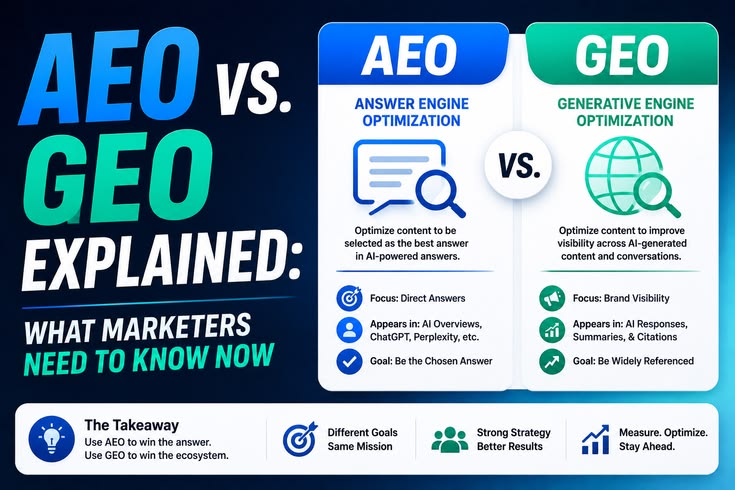
GEO – Generative Engine Optimization
GEO refers to strategies designed to improve visibility in generative AI search experiences.
AEO – Answer Engine Optimization
AEO focuses on making content useful and accessible for answer-focused search experiences.
While these terms are becoming popular, Google’s official guidance says that optimizing for generative AI search is still fundamentally about optimizing for Search, with foundational SEO practices remaining important.
Businesses should be careful about agencies or services promising guaranteed AI search rankings.
There is no magic shortcut.
The strongest long-term strategy remains:
Create helpful content, maintain strong technical SEO, and build genuine authority.
How Businesses Can Optimize for AI Search
Here are practical strategies businesses can follow.
1. Create People-First Content
Write content that genuinely helps your target audience.
Before publishing an article, ask:
- Does this answer a real question?
- Does this solve a problem?
- Is this information useful?
- Does it provide something original?
- Would users be satisfied after reading it?
This mindset is more valuable than simply trying to rank for a keyword.
2. Answer Important Customer Questions
Talk to your sales and customer service teams.
Find out what customers frequently ask.
For example:
- How much do digital marketing services cost?
- How long does SEO take?
- What is the difference between SEO and PPC?
- How do I choose a digital marketing agency?
Create useful pages that answer these questions clearly.
3. Build Topic Authority
Do not publish random articles only for traffic.
Create content clusters around your main services.
For example, a digital marketing company could create content about:
- SEO
- Local SEO
- Technical SEO
- Keyword research
- Content marketing
- Social media marketing
- Google Ads
- Website development
Then connect these articles using relevant internal links.
This helps users explore your website and creates a more organized content structure.
4. Keep Your Content Updated
AI-powered search experiences often rely on current and relevant information.
Review important pages regularly.
Update:
- Statistics
- Services
- Pricing information
- Industry trends
- Examples
- Screenshots
- Outdated recommendations
Fresh and accurate content can provide better value to users.
5. Use Structured Data Where Relevant
Structured data is not a special requirement for appearing in Google’s generative AI features.
However, Google recommends continuing to use appropriate structured data as part of an overall SEO strategy because it can help pages become eligible for rich results.
Depending on your website, useful schema types may include:
- Organization schema
- LocalBusiness schema
- Service schema
- Article schema
- FAQ schema
- Product schema
- Review schema
Only use structured data that accurately represents your content.
6. Create Strong Brand Signals
Your business should be easy to understand online.
Maintain consistency across:
- Website
- Google Business Profile
- Social media profiles
- Business directories
- Industry platforms
Make sure your business information is accurate and consistent.
Strong brand signals can help users recognize and trust your business.
7. Monitor Your Search Performance
SEO reporting is evolving alongside AI search.
Google has introduced reporting and tools related to performance in generative AI search features, allowing website owners to understand how their sites perform in these experiences.
Businesses should monitor:
- Organic traffic
- Impressions
- Clicks
- Conversions
- Top-performing pages
- Search queries
- AI search visibility where reporting is available
Do not focus only on rankings.
Focus on business results.
Is Traditional SEO Still Important in 2026?
Yes, absolutely.
Traditional SEO remains the foundation of online visibility.
Businesses still need:
- Keyword research
- Technical SEO
- Content optimization
- Link building
- Internal linking
- Mobile optimization
- Page speed optimization
- User experience improvements
AI search does not replace SEO.
Instead, AI is changing how search engines understand content and how users interact with search results.
Google’s current guidance explicitly states that SEO best practices remain relevant because generative AI features are built on core Search ranking and quality systems.
The future of SEO is not about abandoning traditional strategies.
It is about improving them.
The Future of SEO and AI Search
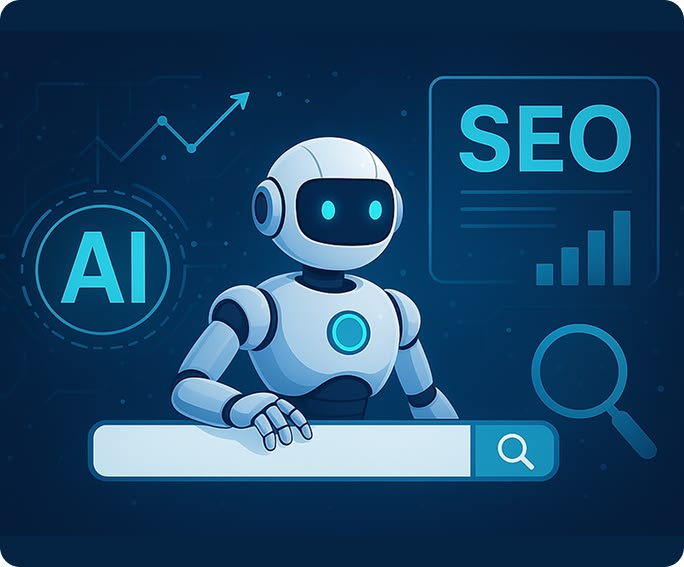
The future of SEO will likely become more focused on quality, relevance, trust, and user satisfaction.
Businesses that rely only on:
- Keyword stuffing
- Low-quality backlinks
- Duplicate content
- Mass-produced AI articles
- Manipulative SEO tactics
will face increasing challenges.
Businesses that focus on:
- Real expertise
- Helpful content
- Strong branding
- Technical quality
- Great user experience
- Original insights
will be in a stronger position.
AI is changing how people search, but one thing remains the same:
Businesses that provide genuine value will have the best opportunity to succeed.
Conclusion
AI search is transforming SEO in 2026, but SEO is not disappearing.
The most important change is the shift from simply targeting keywords to understanding users, answering questions, and providing genuinely helpful information.
Businesses should focus on:
- Creating original content
- Improving technical SEO
- Understanding search intent
- Building brand authority
- Improving user experience
- Maintaining accurate information
- Monitoring search performance
The future belongs to businesses that combine strong SEO fundamentals with high-quality, people-first content.
At KRK Digitals, we help businesses build stronger digital visibility through professional SEO, content marketing, website optimization, and digital marketing strategies.
If you want to improve your website’s visibility and prepare your business for the future of AI-powered search, contact our team today.
Ready to grow your online presence? Visit KRK Digitals and explore our digital marketing services.